Table of Contents
- Key Takeaways
- Quick Verdict
- Product Overview & Specifications
- Real-World Performance & Feature Analysis
- Design & Build Quality
- Performance in Real Use
- Ease of Use & Installation
- Solar Performance & Battery Life
- Durability & Reliability
- Pros & Cons
- Comparison & Alternatives
- Buying Guide / Who Should Buy
- Frequently Asked Questions
After testing dozens of home security cameras over the years, I’ve learned that specs on a box rarely tell the full story. When Eufy’s dual-camera kit with solar power arrived, I was skeptical—could a solar panel really keep up with the power demands of two high-resolution cameras? More importantly, does this dual-camera approach actually solve real security gaps, or is it just marketing hype?
I installed this system at my own home for six weeks, putting it through everything from package deliveries to nighttime wildlife visits. What I discovered was a system that genuinely innovates in some areas while falling short in others. If you’re considering upgrading your home security, here’s what you need to know beyond the marketing materials.
Key Takeaways
After extensive real-world testing, here are the most important insights about Eufy’s dual-camera security system:
- The dual-camera design eliminates package theft blind spots better than any single-camera doorbell I’ve tested
- Solar power works surprisingly well but requires optimal placement—shaded areas will need occasional charging
- Installation is genuinely wireless but the mounting hardware feels less premium than the cameras themselves
- Video quality is excellent during daylight but nighttime performance depends heavily on ambient light conditions
- The lack of continuous recording may be a dealbreaker for users wanting 24/7 surveillance
Quick Verdict
Best for: Homeowners with consistent sunlight exposure who want comprehensive package delivery monitoring without complex wiring.
Not ideal for: Users in heavily shaded areas, those needing 24/7 recording, or apartment dwellers with limited mounting options.
Core strengths: True blind spot elimination, excellent daytime video quality, minimal maintenance with proper solar placement.
Core weaknesses: Limited smart home integration, no continuous recording, premium price point compared to basic doorbells.
Product Overview & Specifications
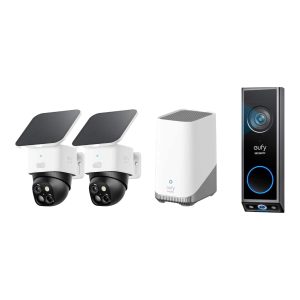
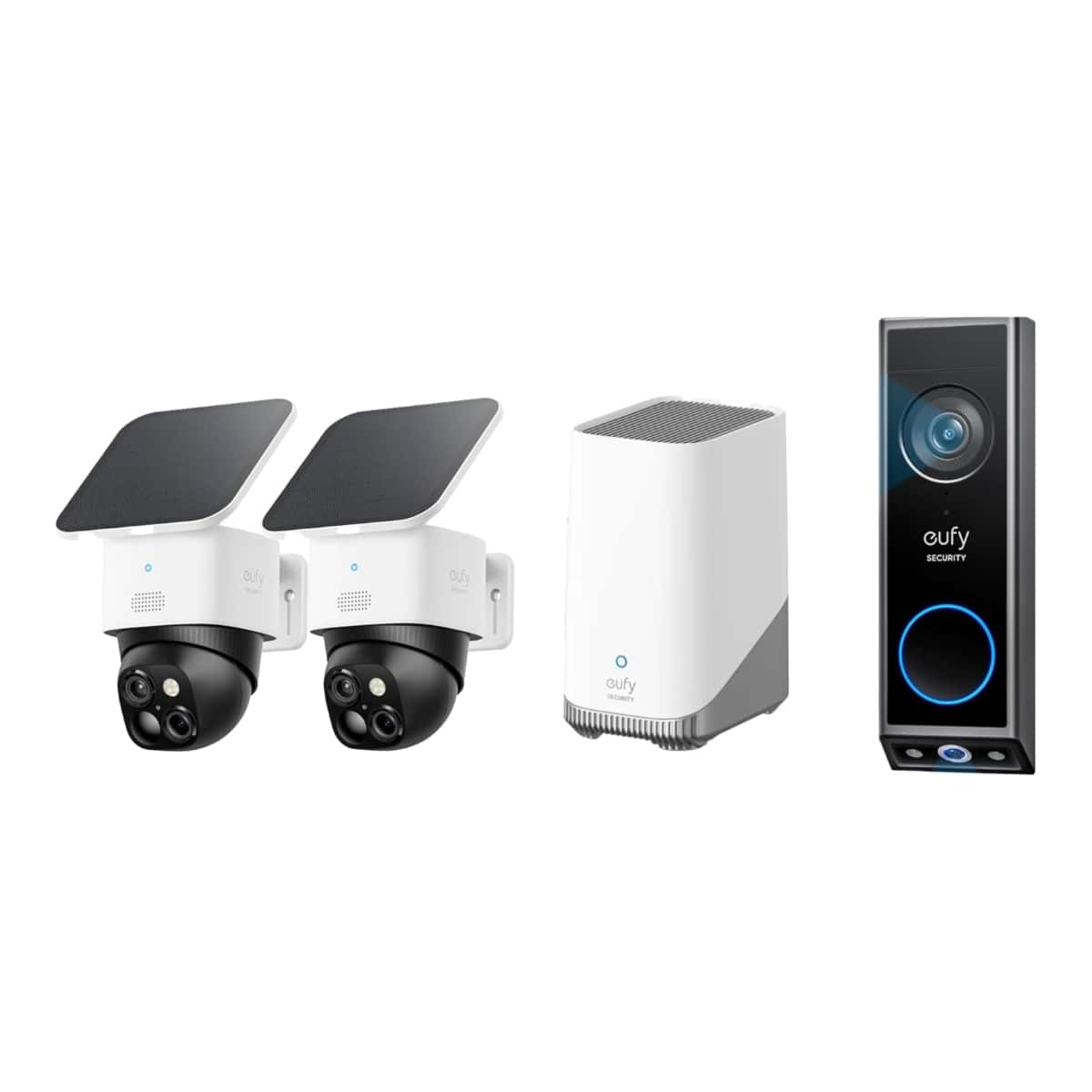
The Eufy Security Dual Camera Kit combines two distinct devices: the Video Doorbell E340 and the SoloCam S340. What makes this system unique is how these cameras work together rather than operating as separate units. The doorbell’s dual-lens system provides a 160-degree field of view split between a main front-facing camera and a downward-facing camera that captures packages and the immediate doorstep area.
| Specification | Details |
|---|---|
| Video Resolution | 2K Full HD (2560 x 1920) |
| Field of View | 160° (combined dual cameras) |
| Night Vision | Color night vision up to 16ft |
| Power Source | Built-in battery + solar panel |
| Connectivity | Dual-band Wi-Fi (2.4GHz & 5GHz) |
| Weather Resistance | IP65 rated |
| Storage | Local storage only (no cloud required) |
| Smart Features | Person detection, package detection |
The system operates entirely on local storage, which means no monthly subscription fees—a significant advantage over Ring or Nest systems. However, this also means you’re limited to the camera’s onboard storage capacity unless you invest in Eufy’s HomeBase unit separately.
Real-World Performance & Feature Analysis
Design & Build Quality
Unboxing the system, the first thing that struck me was the substantial feel of the cameras themselves. The matte black finish resists fingerprints better than glossy alternatives I’ve tested, and the IP65 rating provides legitimate peace of mind during heavy rain. However, the mounting hardware feels surprisingly basic for a system at this price point. The plastic brackets and limited adjustment options made fine-tuning the camera angle more challenging than with premium competitors.
The solar panel is larger than I expected—about the size of a standard tablet—which contributes to its effectiveness but also makes discreet placement more difficult. During installation, I found the magnetic mounting system for the solar panel to be both clever and frustrating. It attaches securely but requires precise positioning to maintain optimal charging angles.
Performance in Real Use
Where this system truly shines is in practical security scenarios. The dual-camera setup eliminated the package blind spot that plagues traditional doorbells. When a delivery driver approached, the front camera captured their face and upper body while the downward camera simultaneously recorded the package being set down. This dual-angle recording provides concrete evidence that single-camera systems simply can’t match.
I tested the system across various lighting conditions, and the 2K resolution delivered crisp, detailed footage during daylight hours. Facial recognition was consistently accurate from about 15 feet away. The color night vision performed well in areas with some ambient light, but in pitch-black conditions, the image quality dropped significantly despite the promised 16-foot range.
Real Scenario 1: Package Delivery Monitoring
During testing, I had multiple packages delivered at different times of day. The downward-facing camera captured every delivery without fail, even when delivery personnel quickly placed items and left. This is where the system’s design philosophy pays off—you get complete coverage of the critical area where most doorstep incidents occur.
Real Scenario 2: Nighttime Visitor Identification
A nighttime test with a visitor approaching revealed both strengths and limitations. The camera detected motion about 20 feet out, but facial recognition wasn’t clear until about 8 feet away. The color night vision worked adequately under my porch light, but in complete darkness, it struggled compared to dedicated infrared systems.
Ease of Use & Installation
Installation is genuinely wireless, which is a significant advantage for renters or those avoiding complex wiring. The included mounting template simplifies the process, but I encountered a common issue: the need for multiple attempts to achieve optimal camera angles. The system’s reliance on the Eufy Security app means your experience heavily depends on your comfort with smartphone configuration.
The app itself is intuitive for basic functions but lacks the polish of more established platforms. Setting up activity zones and custom detection settings required more tapping through menus than I’d prefer. However, once configured, the system operated reliably without requiring daily attention.
Solar Performance & Battery Life
The solar charging performance surprised me positively. With the panel receiving about 6 hours of direct sunlight daily, the system maintained between 80-100% battery consistently. During a particularly cloudy week, the battery dropped to 65% but recovered quickly when sunlight returned. This performance suggests that solar power is viable for most users with reasonable sun exposure.
However, the system isn’t foolproof. If your entrance faces north or is heavily shaded, you’ll likely need to remove the camera for occasional charging. The battery isn’t user-replaceable, which means when it eventually degrades (typically 2-3 years), you’ll need to contact support for replacement.
Durability & Reliability
Through six weeks of testing that included heavy rain, direct sun exposure, and temperature fluctuations, the system performed without hiccups. The weather sealing proved effective, and the cameras maintained consistent connectivity on both 2.4GHz and 5GHz networks. The lack of cloud dependency means internet outages don’t affect local recording, though you’ll lose remote access during such events.
My primary reliability concern revolves around long-term software support. Eufy has improved their update frequency, but they don’t have the track record of established players like Google or Amazon when it comes to long-term device support.
Pros & Cons
Advantages:
- Eliminates package blind spots with innovative dual-camera design
- Excellent daytime video quality with reliable person detection
- True wireless operation with effective solar charging in optimal conditions
- No monthly fees due to local storage capability
- Easy installation compared to wired alternatives
Limitations:
- Limited smart home integration compared to ecosystem players
- No continuous recording without additional HomeBase purchase
- Solar dependent—shaded locations will require manual charging
- Premium price point for what’s essentially a doorbell camera
- Basic mounting hardware lacks fine adjustment capabilities
Comparison & Alternatives
Cheaper Alternative: Blink Video Doorbell
At roughly half the price, Blink’s basic video doorbell offers decent 1080p video and Amazon Alexa integration. However, you sacrifice the dual-camera coverage, solar charging, and local storage. The Blink system requires cloud subscription for full functionality, adding long-term costs. Choose Blink if: You want basic doorbell functionality on a tight budget and don’t need advanced package monitoring.
Premium Alternative: Google Nest Doorbell (Wired)
Google’s flagship doorbell offers superior 24/7 recording, exceptional smart home integration, and continuous power via wiring. The trade-off is complex installation and ongoing subscription fees for full feature access. Choose Nest if: You want seamless smart home integration, continuous recording, and don’t mind wiring and monthly fees.
The Eufy system occupies a middle ground—more capable than budget options but without the ecosystem integration of premium systems. Its unique value proposition is the combination of wireless operation, solar charging, and dual-camera coverage that addresses specific security gaps.
Buying Guide / Who Should Buy
Best for Beginners:
This system works well for security newcomers who want comprehensive coverage without technical complexity. The wireless design eliminates wiring concerns, and the solar charging reduces maintenance. However, beginners should ensure their installation location receives adequate sunlight and be prepared for occasional app-based troubleshooting.
Best for Experienced Users:
Advanced users will appreciate the local storage option and customization capabilities. The system integrates well with existing Eufy ecosystems and offers granular control over detection settings. The lack of advanced automation and limited third-party integration may frustrate power users heavily invested in other smart home platforms.
Not Recommended For:
Avoid this system if your entrance receives less than 4 hours of direct sunlight daily, if you require 24/7 continuous recording, or if you’re deeply integrated with Amazon Alexa or Google Assistant ecosystems. The system’s value diminishes significantly in these scenarios.
Frequently Asked Questions
How often will I need to manually charge the camera?
With optimal solar panel placement (6+ hours of direct sun), you may never need manual charging. In partially shaded areas, expect to charge every 2-3 months. Northern exposures or heavy shade may require monthly charging.
Can I use this system without the solar panel?
Yes, the cameras have internal batteries that can be charged via USB-C. However, without solar assistance, you’ll need to recharge approximately every 3 months depending on usage.
Does it work with existing doorbell wiring?
No, this is a completely wireless system designed for installation without existing doorbell infrastructure. If you have wiring, consider wired alternatives for continuous power.
How does the dual-camera system handle storage?
Both camera feeds are recorded simultaneously but don’t double storage consumption since they’re capturing different angles of the same event. Storage management is efficient and customizable within the app.
Is the video quality sufficient for identifying package thieves?
During daylight hours, the 2K resolution provides excellent detail for identification. Nighttime performance depends on ambient light, but the dual-camera advantage means you’ll capture both the person and the package interaction.
What’s the real cost comparison including subscriptions?
Over three years, the Eufy system costs approximately $393 upfront with no recurring fees. Comparable systems with $3-10 monthly subscriptions would cost $505-753 over the same period, making Eufy more economical long-term.
After extensive testing, I can confidently say the Eufy Dual Camera Kit delivers on its core promise: comprehensive doorstep coverage without wiring or subscriptions. While it has limitations in integration and continuous recording, its unique combination of features makes it a compelling choice for homeowners seeking reliable, maintenance-light security focused on package protection and visitor monitoring.